October 12, 2011

A royal treat in Amsterdam


Silk baby booties made for the birth of Princess Juliana, 1908
Manufactured by luxury shoemaker Dortmond Pennock, Kaatsheuvel, North Brabant


One of the most delightful and unexpected components of Meesterlijk in Amsterdam was an exhibition by the fair's curator, Nicole Uniquole. The collection of historical objects was culled from the Dutch Royal Archives, and installed to create an immediate dialogue with the artists whose work was on view in all the surrounding booths. Luxury items or bespoke designs, once limited to only the most wealthy individuals, are available to a much wider audience today. Custom or limited-edition pieces don't necessarily have to cost a fortune, and working directly with an artist to create something for oneself is a remarkably easy -- and absolutely enlightening -- experience.

The exhibition was also a preview of a larger show that Uniquole is planning at Oranienbaum Palace in Germany next year. The show will combine contemporary Dutch design with pieces from the royal collection, celebrating centuries of unparalleled craftsmanship. The link, you ask? The late-17th century palace was built by a German prince for his Dutch princess bride, and has been newly restored under the patronage of the Netherlands's Queen Beatrix.


Snuff box in the form of a pug, made for Princess Anna of Hanover, circa 1730
Agate, gold and diamonds

Powder case, 18th century
Bone, gold
 
Porcelain cups and saucers, n.d. 
Made at Anna Paulowna, North Holland

Rattle given by the city of Orange on the birth of Juliana, Queen of the Netherlands (1909-2004), April 30, 1909
Maker unknown
Silver, gold, and amber

Fan embroidered with the Alliance Arms of Emma, Queen of the Netherlands (1858-1934)
Made at Boval De Beck, Manufacture Royale de Dentelles, Paris, circa 1880
Brussels lace, mother of pearl, gold, silver, and silk


The most jaw-dropping piece in the exhibition was a diamond and ruby court fan (below), made by the Parisian firm Mellerio dits Meller in 1888. It's part of a parure, which makes it all the more extraordinary. Every night the fan was removed from its vitrine and placed into a vault, whose giant key was secured to Uniqole's purse. "I asked if they wanted me to swallow it," she joked. The diamonds were so dazzlingly sparkly that my camera couldn't focus.


For a peek at the restored palace and more information on the 2012 show, click here.


October 11, 2011

The magic behind the lens

Los Angeles-based photographer Jim McHugh

This Thursday, October 13th, marks the opening of photographer Jim McHugh's exhibition, Studio Visits, at Timothy Yarger Fine Art in Beverly Hills. The installation is part of the Getty initiative Pacific Standard Time, and features images of David Hockney, John Baldessari, Beatrice Wood, Robert Irwin, Ed Ruscha, Lita Albuquerque, Don Bachardy, and Ed Moses -- and many others.


Sam Francis in his Studio, Santa Monica, CA. 1983


Dennis Hopper, in his painting studio, North Carolina. 1999

The show spans several decades, from 1978 to the present to be precise, and as Yarger writes on his site,"What is most clear about these photographs is the great respect and exuberance the photographer holds for his subjects and their work." Having watched Jim in action as he photographed Karl Benjamin's home and studio for our current issue, I can fully attest to that. It was easy to see why so many artists have so willingly opened their doors to him.


Timothy Yarger Fine Art
354 North Bedford Drive
Beverly Hills, CA 90210 
310-278-4400    


October 10, 2011

In the company of friends

Community & Co. owner Jennifer Ridel (left) and artist Aubrienne Roche

Anyone happen to catch Bill Clinton on Christiane Amanpour a couple of weeks ago? She essentially asked him, "How do we get the economy rolling?" His answer: "Networks of collaboration." He then spoke beautifully to the point that businesses are stronger together than they are as isolated entities.

We couldn't agree more.

So, Jen Ridel and Julie Du Brow, thank you for asking Entra to co-sponsor Community & Co.'s opening party! We were honored to work with you and to help create such a fun event.

A few party pics -- courtesy of photographer Bethany Nauert -- are below, with more to come over the next few days. We're going to relish this all week long!


Legendary Lucite furniture designer Charles Hollis Jones and his sister, Jan

Interior designer Oliver M. Furth and Sean Yashar, one of our brilliant public relations advisors

Jen with Extra tv's Michael Corbett and Warren Coulter

RT N the 44s provided some of the evening's entertainment

And the fellas from Tanteo tequilla mixed up some seriously delicious cocktails

October 6, 2011

Entra chats with Ancestry.com


Talking about our September/October feature on dealer Cynthia McKinley's collection of portrait miniatures got us thinking more about the importance of visual clues to our past. Family photographs and portraits, if we're lucky enough to have them, offer a means of better understanding ourselves today -- where we are in our lives, and how we got here. But it's not just faces that tell the story, it's hand-written passenger lists, images of the ships that carried our families, certificates of marriage (sometimes beautifully illustrated, sometimes simply typed), and old maps with long-forgotten town names. It's a fascinating -- and absolutely addicting -- kind of research, so we sat down with (well, from our respective computers in San Francisco and Los Angeles, anyway) Ancestry.com's content team and asked a few questions about how they're making the most of digital images.


Ancestry.com's roots are in publishing in the 1980s, but it went online in 1996. Since its launch, how has the addition or use of digital images changed over the last few years?
The image component has exploded. Initially, Ancestry collections were electronic databases, and then more and more images were scanned from microfilm. In 2006–2007 we were producing millions of images, and now we’re producing tens of millions of images per year.

What kinds of images are available on the site, and where do they all come from?
Most of the images on the Web site are of historic documents, including census records, birth, marriage, and death certificates, passenger lists, and military records. In addition, our subscribers have also added millions of their own unique images from family collections that often include portraits, letters, and personal documents. (Members can also share the images. For example, if you find your great-great-uncle pictured in another member’s tree, you can save the image to your own account.)


An added element of fun? Celebrities! Above is Ancestry.com's digital capture of the late Elizabeth Taylor's birth certificate.

How have other historical databases added to Ancestry.com’s visual offerings?  
Although we have no formal relationship with the Library of Congress, we have published portions of their publicly available historic photo collection, which includes over 340,000 photographs from eleven separate collections held by the library’s Prints and Photograph Division.


Sites like ancestryimages.com offer an vast selection of historic maps, like this engraving of Cambridgeshire published in London in 1837, or a Russian map from circa 1863 (detail below). They can be used simply for free online research, or reproduction prints can be ordered for a nominal fee. 


What can people learn from family portraits, or what does it add to a family tree?
There is a lot to be learned from family portraits, as they can add much more than smiling faces to a family tree. Especially in the case of older imagery, a portrait can identify the size of a family or specific members, a location, and even a timeframe. This information can be extremely useful, especially if there is a lack of paper records for the family members. Most of all they can bring ancestors to life by adding a face to a name you have heard over the years.

What’s ahead for members? Will they be able to upload home movies at some point?
We currently allow members to record audio onto the site. We are continuously looking for ways to improve the user experience and add features that improve the ability to preserve family history. As for video there are no immediate plans, but it is definitely a possibility in the future.

And what else do they have planned for the future? Another season of NBC's Who Do You Think You Are, airing this coming spring, and including actress Marisa Tomei.

October 3, 2011

Love to learn?


Then  do we have the book for you.

For those excited by the more, ahem, nerdy pursuits (history, botany and zoology, for example), we bring you The Art of Instruction, by Katrien Van der Schueren, owner of the eclectic gallery voila! in Los Angeles, and published this month by Chronicle.

Van der Schueren, who was born in Belgium, has been collecting education charts since she was a child, and it’s a passion she’s turned into a most curious and visually engaging new book. “The first educational wall charts were likely printed in Ger­many around 1820, when compulsory schooling began to spread throughout Europe and classroom size increased,” she writes in the introduction. “The continent was facing the Industrial Revolution, rapid popula­tion growth, and a new perspective on education: learning as a fundamental human right. Governments saw it as their duty to mandate schooling, and this shift created a sustained and thriving market for the illustrated charts.”

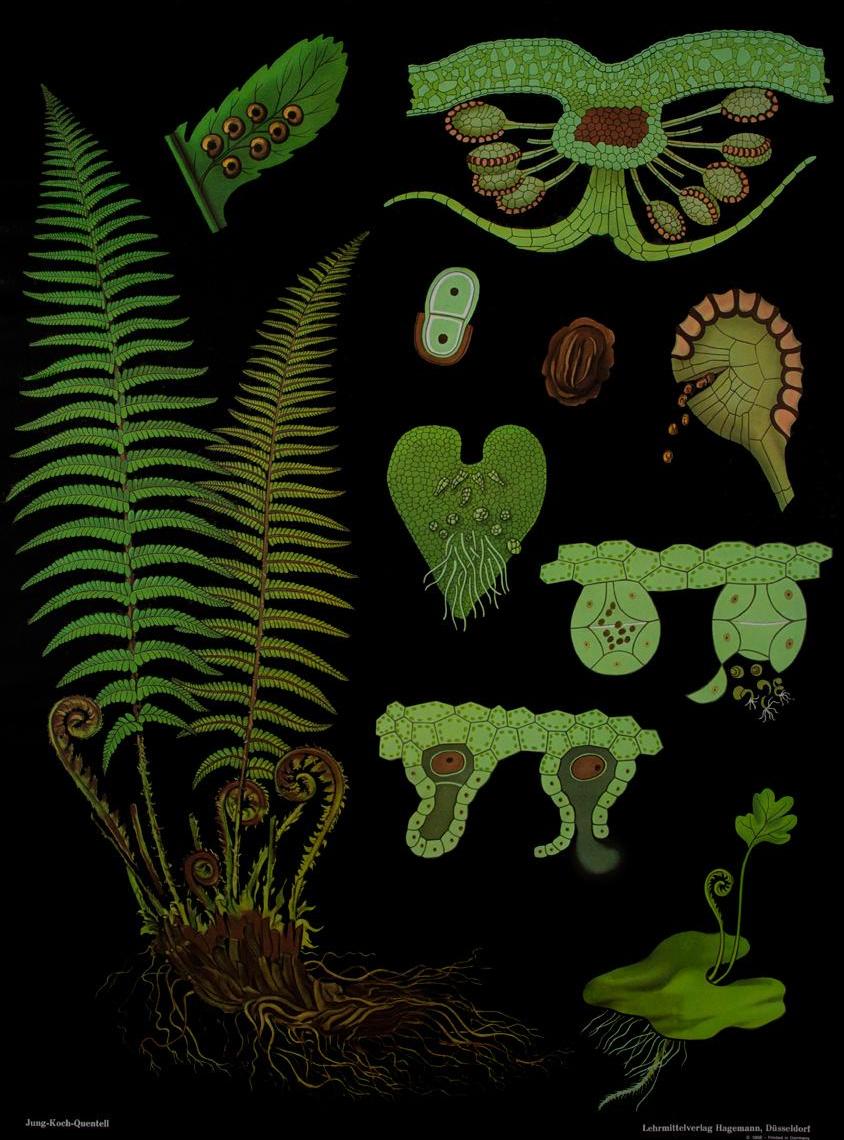
plate 16
Male Fern: Polystichum filix-mas
Fern plant with fronds in various stages of development; Underside of a pinnule with soris; Transverse section of a pinnule with secondary veins, sporangia, and indusium; Mature sporangium; Mature spore; Germinating spore; Prothallus (underside) with rhizoids, antheridia, and archegonia; Opened antheridium with escaping antherozoids; Archegonium with oosphere and mucilaginous apex; Prothallus with young plant.


The popularity of charts peaked between 1870 and 1920, when they were translated into different languages and distributed around the world. “The size, vibrant color, and rich detail of these illustrated charts not only made them an ideal medium for teaching classifications in nearly all branches of biology, but these characteristics also lent them an aesthetic quality. The charts served a dual role, as both scientific tools and works of art.”

Some of the charts (like the fern seen above) were large in scale and designed so that they could be seen by everyone in the classroom. They needed to be bold in order to capture the students’ interest and were intentionally designed without any or much text. (That was left to the accompanying books.)


plate 79
Hedgehog: Erinaceus europaeus
Animal in walking position. The spiny coat of the back gives way to hairy skin on the ventral side; Rolled-up animal with spines standing on end in all directions; Hedgehog, rolled up. The spiny coat in front is removed; The cap-formed dorsal muscle and the strong orbicular muscle form a pocket into which head, tail, and extremities are withdrawn; Soles of the fore and hind feet with the thick pads; Skull of a hedgehog with lower jaw; Molar with crown, seen from above and from the side; A spine with bright and dark areas. On the left, a cross section of a spine, showing the interior structure. In the cuticle, radial prominences give the appearance of a furrowed surface.
Illustration by Gottlieb von Koch (1849–1914)

“For a century, roughly between 1850 and 1950, charts were fundamental tools in education. The number of charts that had been printed or handmade by individual professors and teachers worldwide during this time was likely in the hundreds of thousands,” Van der Schueren writes. “Today, it’s likely that only a frac­tion has survived. Smaller class sizes and richly illustrated schoolbooks for individual use gradually diminished the chart’s popularity, as did the introduction of technologically advanced visual aids, such as the slide projector. Although some manufacturers flourished until late in the 1980s, and production does continue today on a small scale, pictorial wall charts gradually lost their universal appeal after the 1960s.”

As we bring you in Entra’s Archivalia column, which highlights newly digitized and previously unseen collections of works on paper, technology has enabled museums and universities to reconsider often overlooked materials in their collections. “Considered ephemeral at the peak of their popularity, these charts were seldom cataloged by the institutions that used them, or even by the compa­nies that printed and sold them,” explains Van der Schueren. The Art of Instruction offers a beautiful reintroduction of the material and, as was the original goal of the charts, makes looking and learning fun.


plate 98
Red Star Coral: Astroides calycularis
Stony corals of the Mediterranean: a) living star coral, b) living branching coral, c) limestone skeletons of dead star coral; Young polyp of star coral opened to show gastrovascular cavity and skeletal structure (slightly diagrammatic); Transverse section of a polyp (enlarged); Part of the theca with dividing walls in transverse section: a) portion with three septa (enlarged), b) a single dividing wall with muscle attachment, germ cells, and showing the thickening of the wall (greatly enlarged), c) thickened wall showing stinging and glandular cells (very much enlarged); Development of stony coral: a) young larva in water, b) shapeless larva swimming, c) larva with early tentacle formation, d) larva with short tentacles settling down (very much enlarged).


The book can be purchased through Amazon, or directly through the gallery.